Hello everyone! Don't worry, I haven't forgotten about you. I just have been pretty busy of late to
dedicate time writing on my blog. But you won't be disappointed with what I'm about to write! I've had an exciting adventure in the northwest of Spain, in the autonomous community of Galicia. Two things you should know about Galicia are that it rains quite a lot so everything is green and that it has the best seafood in all of Spain.
 |
Zaragoza is in the big pink region to the right. Santiago de Compostela
is in the green region to the far left. The train's route went from
Zaragoza to the north towards Navarra and then turned west towards
Galicia. |
 |
| Santiago de Compostela is in A Coruña. |
I went to Galicia as part of a program in SYA Spain called Cinco días en... (Five days in...) another city in Spain. The school chose where all the students would go. I was really lucky and they gave me Galicia!
Tuesday, February 12 was the big day. I woke up earlier than usual to get ready. I packed
everything I thought I would need, including one umbrella, one pair of rain boots, and one rain
jacket. I really didn't want to get wet like when I was in Pamplona. I learned my lesson then. I
went to school with all my stuff because my train would leave at 11:30 am, and I thought that I had to go to the one class that I'd have time for. But it turned out that since my train left so soon
after the class I actually didn't have to go to it, so I was excused. All the students going to
Galicia left around 10:30 am for the station. There were 11 of us total, 8 going to Santiago de
Compostela and 3 going to A Coruña, a city on the northern coast of Galicia.
We boarded the train and sat down. According to the tickets that the school had given us, the
people going to Santiago sat together and the people going to A Coruña sat together. The
departure and arrival times were also shown on the ticket, and we would be riding on the train
for about 10 HOURS straight. It was going to be a very long trip. I tried sleeping--that didn't work. I had brought my computer, so I watched some videos I had on it. The route the train took wasn't directly to Santiago. First we traveled north through the community Navarra and then we headed west along northern Spain.
We arrived in Santiago a little past the scheduled time. When we got off, the coordinator, Javier
González, was waiting for us. He spoke to us in English. He had a strong British accent
because he had studied English in the UK. He led us to our new host families who were all
standing outside. It was deja vu. I had the sensation of doing this almost exact same thing five
months before. I met my host sister first. Her name is Gemma. (The G is pronounced like an H.)
Next I met the mother, Isabel, a younger brother, Isidoro, and the father, also called Isidoro. The
youngest son, Rodrigo, had stayed home because only five people fit in their car. They drove
me to their house which wasn't very far away. The first thing I noticed was that their house was
very big, much bigger than my host family's apartment in Zaragoza. I loved it because there was
a lot of space and it didn't feel tight or cramped. They showed me my room which was on the
top floor, and then gave me a tour of the rest of their house. Once we finished we ate a little bit
so that we weren't hungry and then went to bed.
The next morning I got up around 10:30 am and went downstairs to eat breakfast. Gemma,
Isidoro, and Rodrigo were already there, and the parents had left earlier. After breakfast we went up to the TV room and relaxed for a little bit. Even thought it was Wednesday, we didn't have school because they were still celebrating Carnaval, which is a huge festival that occurs right before Lent. It's like Mardi Gras in the US.
Around noon Gemma and I met up with another Spanish girl, María, who was hosting another
American girl, Nina. We first visited El Museo de Pobo Galego. The name is in Galician. In
Spanish it's Pueblo Gallego, which means the Galician People. The museum is solely about
Galicia and its culture. One of its more well-known aspects is its three spiral staircases which
lead to the different floors with the exhibitions. I thought the staircases were really cool. We saw
boats and ships and fishing equipment used by the Galicians, traditional clothing, what old
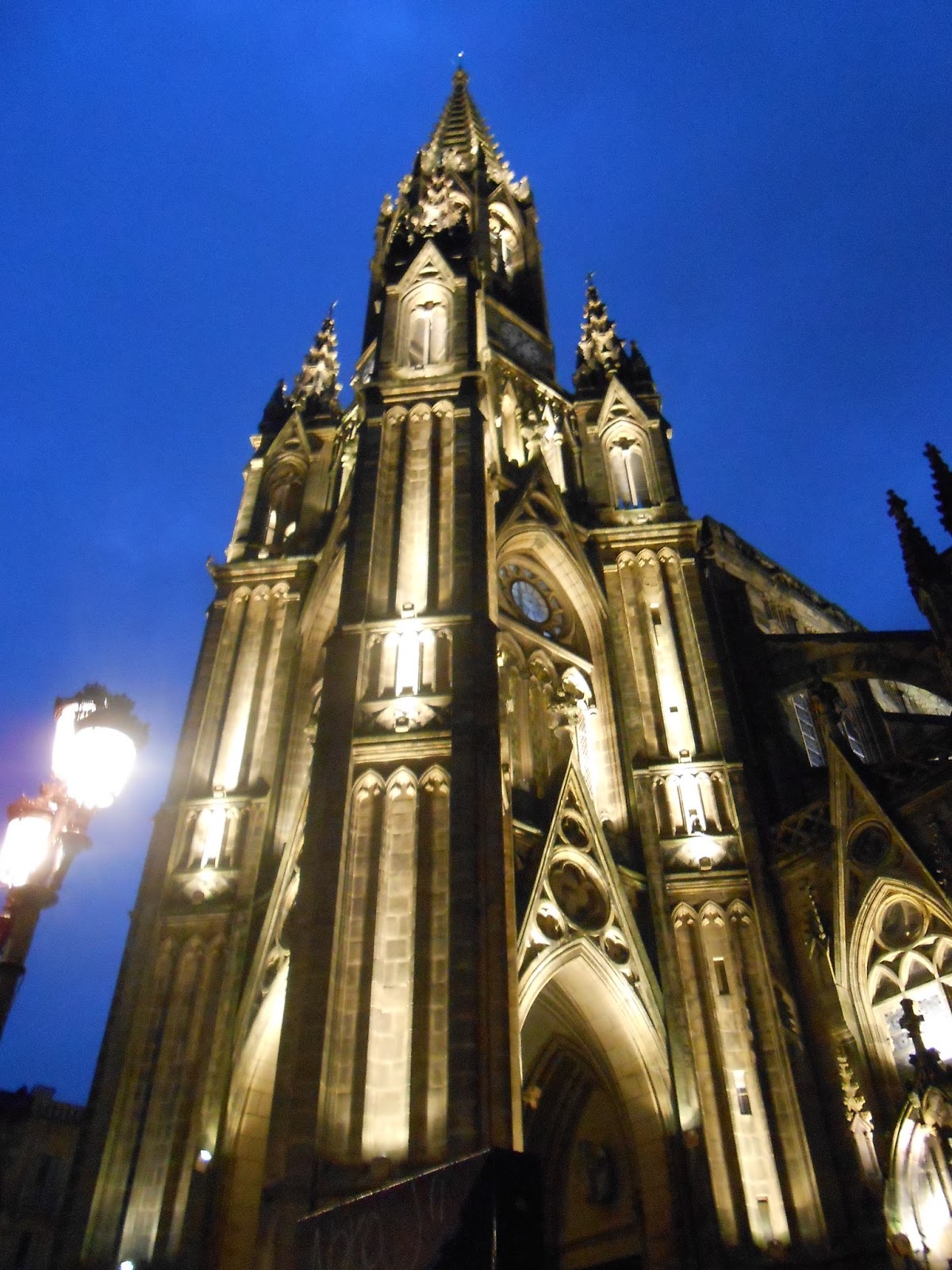
rooms looked like, and the church that was connected to the museum. Afterwards we visited the famous cathedral in Santiago de Compostela. It was amazing to finally be standing in front of this ancient structure that I had heard about for so long. We entered the cathedral, which you can guess was very impressive. There's a part that painted all in gold which contains a statue of St. James that you can hug. I did not do that. Another part contains the remains of the saint in a
silver chest. I did see that. When we finished Gemma and I returned to her house to have lunch.
 |
| María on the left, Nina on the right. |
 |
| Model of a fishing town. |
 |
| Traditional women's clothing. |
 |
The spiral staircase! (Can you see the three
different stairs?) |
 |
| They're floating! |
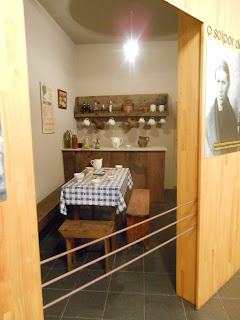 |
| Model of an old kitchen. |
 |
| Model of an old classroom. |
 |
| Scary costumes. |
 |
| The cathedral. |
After lunch we went back out again. This time we visited La Ciudad de la Cultura, meaning the
Cultural City. There are a lot of academic buildings, for example, a library. All the buildings have
really interesting shapes. Instead of being perfect rectangles, their roofs slope up and down to
form hills. You can even walk on some of the roofs that aren't too steep. The architect who
designed them is Peter Eisenman, an American. Some of the buildings aren't finished yet. The
City just began construction a few years ago.
 |
| Look at the weird roofs! |
 |
A really creative sculpture in front of the
library. It looks like a donut made out
of books. |
We met María and Nina again, plus another Spanish and American pair, Jaime and Will. We
walked back towards the center of Santiago de Compostela and met more host siblings. We all went to a bar and sat and talked for awhile. More Spanish teenagers came and sat down with us. We were easily fifteen people, very possibly more. When it was close to dinnertime, Gemma and I left for her house.
For dinner we had mussels and fish. Both were very good. The parents asked me a lot of
questions about Zaragoza and my home in the US. I found out that the father studied abroad in
the US when he was my age! He stayed with an American family in Maryland. He showed me a
photo album that has pictures and papers of when he went. It was really cool to look at them and to know that he had gone through a very similar experience like what I'm doing now. We share that in common.
The next day was school. I had to wake up at 7:30 am. School started at 8:20 am. I walked with
Gemma and Rodrigo to the school building which was near by. Once we arrived Rodrigo
headed towards a different building for the younger students. When we walked into the
classroom, several American students were already there. We all sat next to our host siblings.
The first class was History. They were studying the Russian Revolution, but the teacher took
advantage of our presence and decided to ask us about our knowledge of the subject to see
how much we know about Russia's history. He called on me first and I was unprepared, so I
didn't say much. Plus I was pretty embarrassed. But one of the other girls was able to supply a
lot of information. The teacher seemed pleased. The next class was Economy. The class is
usually in Galician, but since we Americans were there, the teacher spoke in Spanish so that we could understand. The next class was Contemporary World Sciences, and at the moment they were studying Biology. That class is also usually in Galician, but the teacher spoke in Spanish for the same reason. I recognized some of the topics from my freshman year of Biology. Next was Math, which I was looking forward to. They were doing limits, which I've done a little of before, but not much. I had no clue how to solve the equations on the board. I think they were more advanced than my level of math, but I'm not sure. Like the previous two classes, it is
usually held in Galician, but the teacher spoke in Spanish for us. The next class was Galician,
but Javier González, the coordinator and English teacher, took all the Americans and gave us a
tour of the school. It's a very old building that used to be a convent. We saw the old part that's
made out of granite and then the attached church. We met the director of the school, a very nice
old lady, who also showed us around and explained the history of the building. At the end of the
tour Javier took us to his English class to help out. Like I said before, he speaks with a British
accent, so the Spanish students are accustomed to hearing that accent and not the American
one. First we listened to a recording about how to survive if you're alone outside and answered
questions about it. Then Javier split us all up into eight separate groups: one American and the
rest Spanish. We looked at pictures in their workbooks and the Spanish students had to
describe what was happening in English. It was a new experience for me and I liked it.
For lunch the Spanish kids decided on a restaurant called Muerde la Pasta, which means Bite
the Pasta, in the mall. It was perfect. It was a buffet full of all-you-can-eat pasta and pizza. There
were so many types of pasta, I couldn't choose. There was even chocolate pasta! I didn't try it
though because I wanted to save room for dessert. I had a bowl of soft-serve ice cream. Yum.
For the rest of the afternoon we walked around the mall. Some people bought stuff. Gemma and I returned to her house a little before dinner.
The next morning (Friday) I had to wake up at the same time, 7:30 am. Gemma, Rodrigo, and I
walked to school together again and parted ways once we arrived. The first class was Economy, a class we had had the day before. During the next period, instead of being in class,
Javier took us on another tour of a local market and another part of Santiago de Compostela.
Even before we saw the market we could smell it. The fish smelled so strong. It wasn't pleasant.
We first walked through a long building full of different stalls selling different foods. There was
meat and cheese and fish and other seafood. Everything was definitely fresh. A lot of the
seafood, like the crabs and shrimp, were still alive and moving. In some of the meat stalls, I saw
pig heads and feet and livers, full chickens, and even cut-open animals with their insides
spewing out. Not what I expected to see, but it was interesting.
 |
| Live crabs! |
We left the market and walked around a different part of the city while Javier explained it to us.
All of the buildings looked really old.
We returned to the school in time for the next class, which was Physical Education. Gemma told
me that her class was putting on a play, so we had to walk to the auditorium. Two other
Americans, Jordan and Nina, came along, too. We three sat in the seats and watched the class
rehearse the play. At the end they were going to bow and then do the Gangham Style, but it
turned out to be too hard, and so they switched it to the Macarena. Jordan, Nina, and I got up on
the stage to do it with them. That was a lot of fun. The next class was Spanish. I thought that it
would be like what Americans consider English, but it was a little different. They were doing
debates. The topic for that day was about the usage of technology. The teacher asked me and
the other Americans what we thought about technology in the US and whether it's a good or bad thing to allow students to use computers during class. We came to some good conclusions. After Spanish was English. All the Americans came to this class again and we did the same exercises as the day before. The last class was French. The students listened to songs in French and the teacher went around the classroom asking questions. It was very relaxed.
That afternoon seven of the Americans went to visit the western coast of Galicia. We visited an
island that used to be a Celtic settlement. Galicia has a lot of Celtic influences. We road in two
separate cars and it took us about an hour and a half. When we neared our destination we could see the ocean from the car windows. It looked so beautiful. It reminded me of Maine a lot. To reach the island we had to walk down a very long trail. It took us maybe 20 minutes. At the end there was also a nice little beach. There were also people there already. We crossed the beach to the island and started climbing. There were rings of rocks which used to be rooms. We climbed atop some big rocks and looked out across the water. The view was spectacular. It felt as if we were on the top of the world. We stayed on the island for several hours. I didn't want to leave. It was so amazing. We returned to the school where the Spanish kids were waiting for us. Gemma and I returned to her house, and her family and I ate dinner.
 |
| The beach! |
 |
| On the island. |
The next day, Saturday, my host family planned a trip to Pontevedra, a city south of Santiago de
Compostela. My host dad was born and grew up there. We left Santiago around noon and
stopped in a city to eat lunch. We ate in a fancy hotel on the water. In order for me to try the
seafood, the parents ordered octopus, small shrimp, something that looked like clams, and
lobster. Everything was delicious, even the octopus! I want to try it again. For dessert I ate a
traditional pastry that is made out of the crepe bread and filled with chocolate. It was so good.
After we finished we went outside and walked around the area a bit. I saw a very old church that
was completely covered in seashells. It was very pretty.
 |
| Me with Gemma, Isidoro, and Rodrigo. |
We got into their car and continued to Pontevedra. Physically it looks very much like Santiago.
The streets and buildings are very similar. The only main difference is that it's a lot smaller. The
father told me a lot about the city. He showed me where he was born and explained the
buildings and the plazas. He knew a lot. After several hours we got into the car again and
returned to Santiago.
 |
| Me with Gemma. |
 |
| My host family in front of a church. |
That night I stayed in the house and got ready to leave early the next morning. The past four
days had flown by so fast. I wish I could've stayed longer. I enjoyed every minute of it.
The next morning (Sunday) the train left around 8:45 am. The parents and Gemma drove me to
the train station. The two brothers stayed at home. We arrived at the station about 15 minutes
before the departure. There were already several Americans with their host families. Everyone
looked tired. The rest of the students and their host families quickly arrived after that. When the
train pulled into the station, we all walked to the platform and I said my last goodbyes to my host
family. I had had such a great time. They told me I'd be welcome back anytime.
The train ride back to Zaragoza felt a lot shorter than the one to Santiago de Compostela. It was technically shorter and I slept for most of the way. It felt a bit weird being back in Zaragoza
because we hadn't been there for the past five days and everything looked familiar and new at
the same time.
I loved being in Galicia. Not only did I have a wonderful host family, but the scenery was also
breathtaking. It felt alive. I think my host family and I were matched very well. We shared a lot of
interests. First of all, the father had studied abroad in the US for a year like I'm doing now. The
mother has also studied English. As for their children, they all play the piano. Their piano is in
the bottom floor. Rodrigo loves to play video games, so one night he and I played together on
their Wii. He also showed me some computer games he really likes and I showed him one I
really like. Isidoro is interested by math and sciences. He built his own computer! He bought the
pieces and put them all together. He showed me the finished product. I saw the inside with all
the tiny and complicated wires and buttons and knobs. He even personalized it a bit by adding
blue lights. It was very cool. Gemma was a very nice host sister. She helped me a lot with
adjusting so quickly to a new city. I really appreciated it.
I miss Galicia. I definitely want to return again to see more of it and to visit my host family. They
told me that they want to visit Boston so I told them to call me if they're ever there. It'd be so
cool to see them in the US and to show them around where I live. I'd be returning their favor in a
way.